
A contract with your broker, or the coin itself

Two people can say they bought Bitcoin and own completely different things. One holds an asset. The other holds an agreement with a company. Know which one you are before you press the button.
What you actually own
Trading a crypto CFD through a broker means you never touch a coin. You and the broker settle the difference between the price when you opened and the price when you closed. Your money sits in a trading account, and there is no wallet and no private key anywhere in the story.
Buying on an exchange means the coin exists on the record with your purchase attached to it. There is a third possibility, and it is the most common: the coin sits in the exchange's own wallet with your name on an internal balance. That is a claim on a company, not property in your hand, until you withdraw it to a wallet whose key you hold.
| CFD with a broker | Bought on an exchange | |
|---|---|---|
| What you hold | An agreement about a price | A coin, or a claim on the exchange until you withdraw it |
| Cash needed | Margin only, so a small deposit controls a large position | The full value of what you buy |
| Main charges | Spread, sometimes commission, and financing every night you hold | A fee on the way in and on the way out, plus a network fee to move coins |
| Can you short it | Yes, as easily as buying | Not without borrowing or a derivative |
| If the company fails | Client money rules and a regulator, depending on the licence | Depends entirely on that venue, and often on a court in another country |
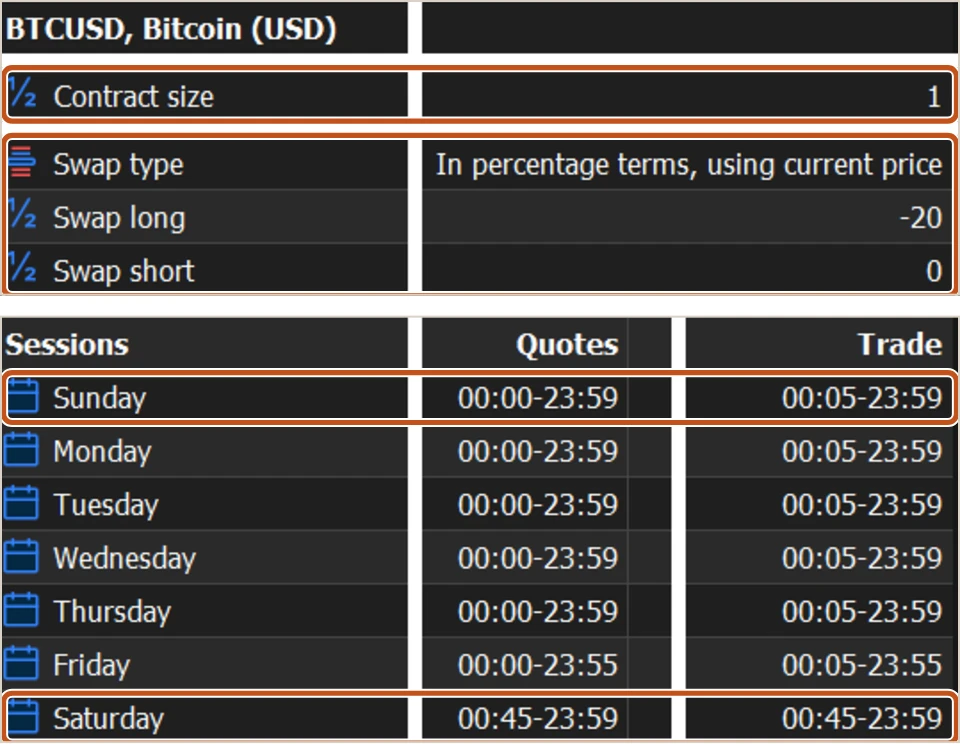
| Hours | Your broker's crypto hours, which may pause at weekends | The market's hours, which are all of them |
The cost that surprises people
The nightly financing charge is small enough to ignore for a day trade and large enough to matter for a swing. It is charged every night the position is open, winning or losing. Exchange buying has no nightly charge, but it takes a percentage of the value on both sides and requires the full cash.
One month, two routes
- You want exposure worth USD6,000 of Bitcoin, held for 30 nights.
- By CFD: financing at roughly 0.03 percent of position value per night is about USD1.80 a night, so about USD54 over the month, plus the spread on entry and exit.
- By exchange: a fee of 0.20 percent each way on USD6,000 is USD12 in and USD12 out, about USD24 in total, and no nightly charge.
- Now change the holding period to two nights. The CFD costs about USD3.60 in financing. The exchange still costs about USD24 in fees.
Which route is cheaper depends entirely on how long you hold. Short holds favour the contract, long holds favour owning the asset. Check the actual numbers on your own account before you choose.
Trading carries risk and you can lose money.
Leverage is the real difference
That was arithmetic. This part is behaviour. A CFD lets you control a large position with a small deposit, on the most volatile thing most beginners have ever traded. That combination is why the loss numbers for retail contract trading look the way they do.
Buying the coin outright removes the financing charge and the margin call, and hands you custody risk instead. Neither route is safe. They are differently unsafe, and the choice should follow your holding period and your ability to look after a key, not whichever one a video made exciting.

Leverage does not make a small account into a big one. It makes a small account into a short one. On a market that can move a long way before breakfast, the margin call arrives while you are still asleep.
Trading carries risk and you can lose money.
The picture to keep
Renting a car for the weekend or buying one. The rental costs you every night you keep it. The purchase costs you the whole price up front, and then it is yours to park and to lose.