
Why it still needs a human

Automation moves the work. It does not remove it. Your job changes from taking trades to watching a thing that takes trades, and that second job is quieter, less exciting, and far easier to quietly stop doing.
Three jobs no program does for itself
| The job | What it means in practice |
|---|---|
| Monitoring | Is it still running, still connected, still logging, and are the trades it takes the trades the rules actually describe? |
| Knowing when to switch it off | Deciding the conditions in advance, writing them down, and acting on them later without renegotiating. |
| Understanding what it is doing | Being able to say in one sentence what opens a trade and what closes it. Without that sentence there is nothing to supervise. |
The weekly check
- Open the terminal and look at the Toolbox. On the Experts tab, is the program still writing log lines, and are any of them errors?
- On the Journal tab, look for restarts, disconnections and rejected orders since your last check, and for the lines that record the program being loaded or removed.
- On the History tab, read the trades it actually took and compare them to the rules you believe it follows, exactly as in the History tab as a journal.
- Compare the average loss and the largest loss against what the test said they would be.
- Compare the account's worst drawdown so far against the worst the test ever produced.
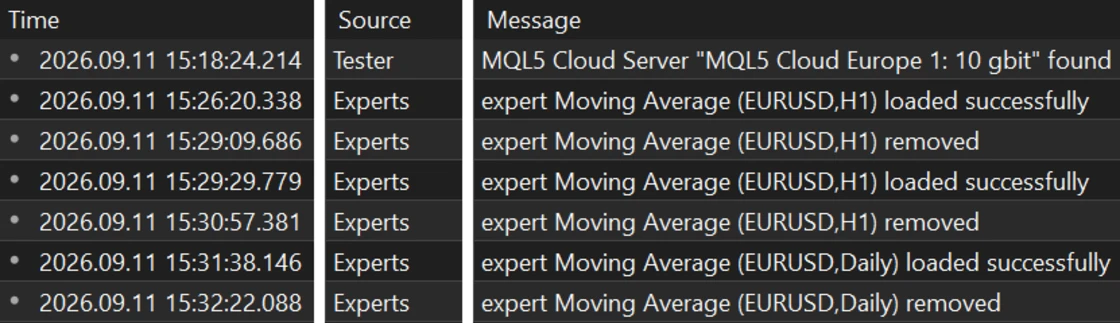
Five minutes, once a week, and almost every technical failure in the previous lesson shows up in one of those five places long before it shows up in the balance.
Decide the off switch before you need it
In the moment, nobody switches a program off. They give it one more week, because the losing run is surely nearly over and stopping now would make the loss permanent. So the decision has to exist before the moment arrives.
- The drawdown passes the worst the test ever produced. The test's worst is a floor, not a ceiling.
- It takes a trade you cannot explain from the rules.
- The broker changes something that matters: spread, swap, symbol name or execution.
- The market it was built for is visibly not the market on the screen any more.
- You have stopped checking it weekly. An unwatched program should be a stopped program.

The decision to switch a program off is never made calmly at the moment it needs making. It is made calmly now, written down, and simply carried out later. A rule you invent while watching the loss grow is not a rule. It is a hope with a timestamp on it.
If you cannot explain it, you cannot supervise it
This applies hardest to a program somebody else wrote. If the seller cannot tell you plainly what opens a trade and what closes it, you are not buying a system, you are buying a mystery with your account attached to it. Module 19 turns that into a checklist you can use on any bot, including ours.
Automation moves you from doing the job to running the job. Running it is still a job, and it is the part nobody advertises.
The picture to keep
The obedient driver still needs somebody who reads the news, watches the fuel gauge, and has already decided in advance what would make them say stop the car.