
What is different, and it is a lot

This is the lesson the module exists for. Everything you know still applies, and the road you are applying it on has no lanes and no police. Read this one slowly.
The picture to keep
Forex is a highway. There are lanes, there are speed limits, there is a closing time on Friday evening, and there are traffic police in the form of regulators, central banks and licensed brokers with segregated client accounts. Crypto is the same journey across an open field. You can go faster, nothing shuts, and no one waves you down. There are also no lanes, no police, and the potholes are far deeper.
Six differences do most of the damage. Take them one at a time.
It never closes, and it never lets you off
There is no Friday close and no Sunday gap. In one narrow sense that is an improvement: a stop can be filled on a Saturday night rather than jumping over the weekend. The cost is that the market is always open and you are not. A position you would have watched all day sits unattended for eight hours every night, and the biggest moves have a habit of landing in them.
There is also no natural stop. Forex hands you a Friday evening whether you want one or not. Here nothing tells you to go to bed, and screen fatigue shows up in your results before it shows in your face.
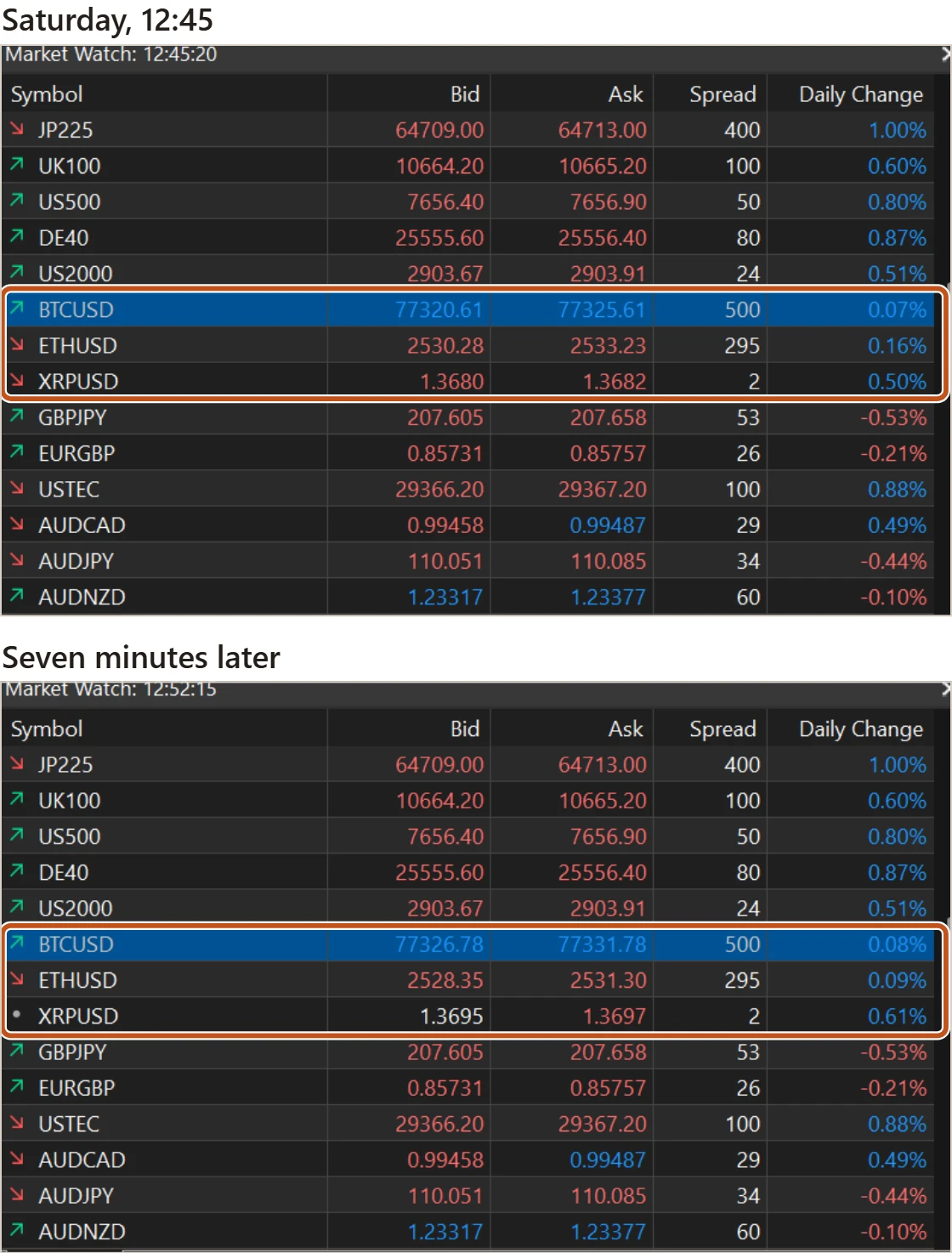

A market that never closes will take your rest if you let it. Decide when your screen goes off before the week starts, and treat that time like a closing bell, because nobody else is going to ring one for you.
It moves several times further, so positions must be several times smaller
An ordinary day on EUR/USD moves well under one percent of its price. An ordinary day on Bitcoin can be several percent, and a bad one far more. Same money risk, same rule from Part One, but a much wider stop, so a much smaller position. Lesson 9 works this through with numbers.
Liquidity is not evenly spread
The largest coins have deep books on the largest venues. Below them, depth falls away fast, and a market order that would be invisible on Bitcoin can move a small token several percent by itself.
There is no central bank
No committee sets a rate for it, so the interest rate and carry logic you learned does not apply directly. What replaces it is the subject of the next lesson.
Where your coins actually sit, and who makes the rules
Coins held on an exchange are not the same as money in a segregated client account at a licensed broker. In most cases the exchange holds the keys and your balance is a claim on that company. If the company fails, you are a creditor in a court process, not an owner collecting property.
A very large exchange failed again in November 2022, freezing customer balances in a bankruptcy still being unwound. Holding your own keys removes that risk and hands you a different one, because a lost key is final.
Rules vary by country and they change. In Nigeria, banks were directed to close accounts connected to crypto dealing in February 2021, and guidelines issued in December 2023 allowed banks to serve licensed virtual asset businesses again. Two changes of direction in under three years, in one country. Check the position yourself rather than trusting a chat group.
Regulation is the least stable input in this market. A rule change in a large country can move price faster than any chart pattern, and it arrives without notice.
Trading carries risk and you can lose money.
The picture to keep
The car and the driver are unchanged. The road has no lanes, no closing time and no police, and the potholes are deep enough to end the journey.