
What is the same as forex

People arrive in crypto expecting a different game and a different set of skills. The skills are the same ones. The car you learned to drive is the car you are still driving.
A price is still a price
There is a bid, there is an ask, and the gap between them is the spread you pay to get in. Bitcoin quoted at 60,000 to buy and 59,970 to sell means the same thing as EUR/USD quoted at 1.0852 to buy and 1.0850 to sell: you start the trade behind, and the market has to move your way before you are level. The lesson on bid, ask and spread needs no rewriting for this market.
Behind the quote sits a book of resting orders, exactly as described in the order book. Market orders take liquidity out of it. Limit orders put liquidity into it. When the book is thin, a large market order walks up several levels and you are filled at a worse average price than the one you saw. Nothing about that mechanism is special to crypto, and everything about it is louder here.
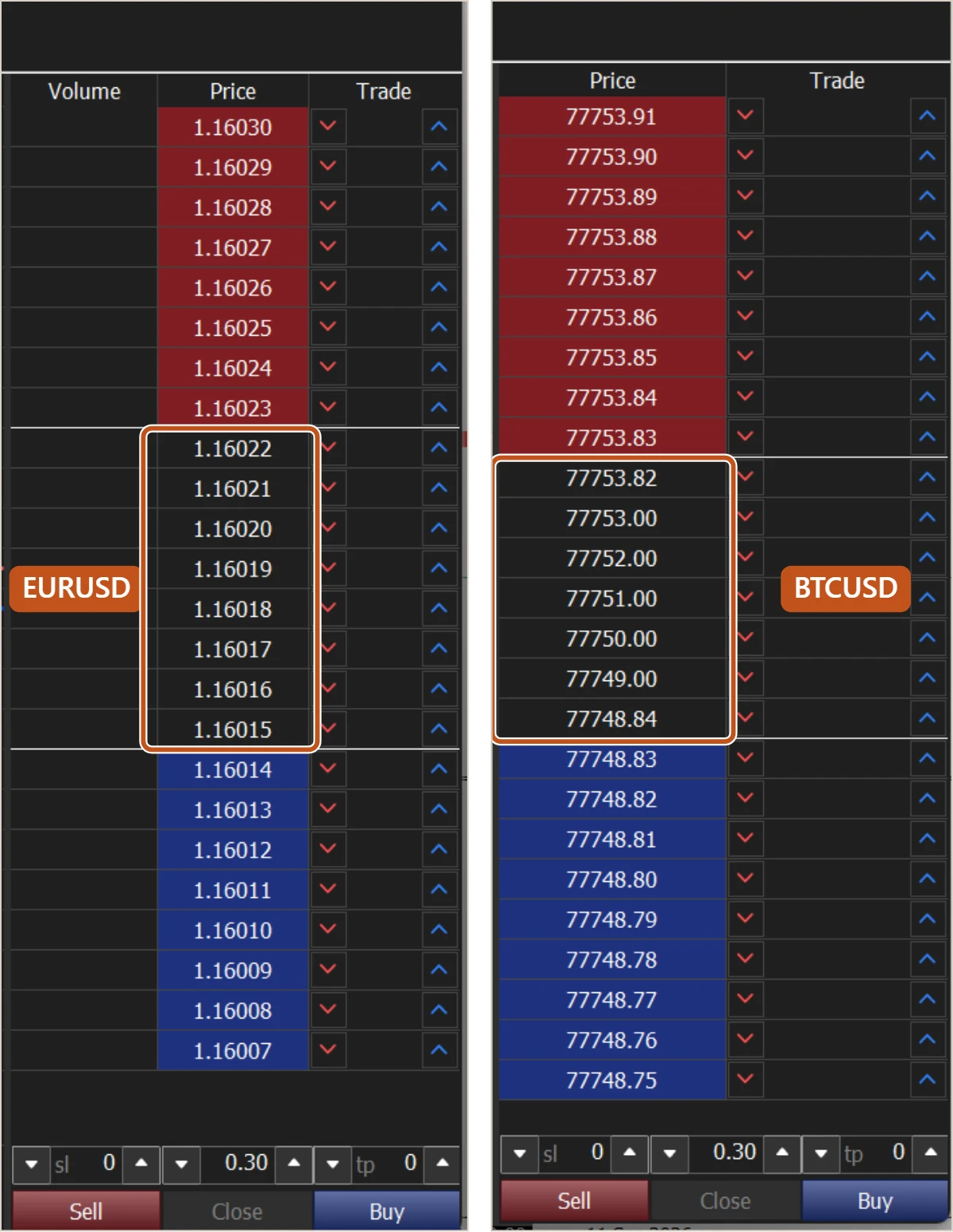
Orders still move price, and flow still comes first
Price does not move because a story is true. It moves because somebody with size had to trade. That is the whole argument of order flow, and it survives the move to a market with no central bank in it. A large holder deciding to sell moves Bitcoin for the same mechanical reason a pension fund moves EUR/USD: the book has to absorb the order.
Stops still cluster above obvious highs and below obvious lows. Round numbers still attract orders. Thin hours still produce ugly wicks. If anything, these effects are stronger in a market that never closes, because there is always a quiet hour somewhere.
Costs still compound
Every cost you met in the three costs is present. Spread on entry and exit. Slippage when the book is thin. A financing charge if you hold a leveraged position overnight, and an exchange fee if you are buying the coin itself. Nothing is waived because the market is new.
The same arithmetic, a different market
- You take 200 trades in a year and your raw edge is worth 0.30 percent of the traded value per trade.
- Round-trip costs on the instrument come to 0.20 percent of the traded value.
- Your net edge is 0.10 percent per trade, not 0.30 percent.
Two thirds of the edge went to costs, and the market was never asked for permission. This is the same sum as a thin edge over 200 trades, run on a different symbol.
Trading carries risk and you can lose money.
Risk management still decides who is left
Drawdown arithmetic does not care what you traded. Lose half an account and you need to double what is left to get back to where you started. The one percent idea in position sizing applies without a single change, and the next lessons will show that it applies harder here, because the numbers you plug into it are so much larger.
So the honest summary of this lesson is that Part One was not forex training. It was market training. Every rule you built there is the rule you bring with you.

Anyone who tells you crypto needs a different mindset is usually selling you permission to skip the risk rules. The mindset is the same. Only the size of the potholes changed.
The picture to keep
Same car, same driving skill, same brakes. You have not been handed a new vehicle, you have been pointed at a different road.