
Trading hours and gaps

Forex taught you a market that runs from Sunday night to Friday night without a break. Indices are not like that. The shares behind them go home in the evening, and they do not work weekends. What happens while they are away is the whole of this lesson.
The cash session: when the shares are actually trading
Every index sits on top of an exchange, and that exchange has opening hours. Inside those hours, called the cash session, real shares are changing hands and the index level is calculated from real trades. Outside them, nobody is buying the companies.
| Exchange and index | Local hours | Lagos time, northern summer | Lagos time, northern winter |
|---|---|---|---|
| New York and Nasdaq: Dow, S&P 500, Nasdaq 100 | 09:30 to 16:00 | 14:30 to 21:00 | 15:30 to 22:00 |
| London: FTSE 100 | 08:00 to 16:30 | 08:00 to 16:30 | 09:00 to 17:30 |
| Frankfurt and Xetra: DAX 40 | 09:00 to 17:30 | 08:00 to 16:30 | 09:00 to 17:30 |
| Tokyo: Nikkei 225 | 09:00 to 11:30, then 12:30 to 15:30 | 01:00 to 03:30, then 04:30 to 07:30 | 01:00 to 03:30, then 04:30 to 07:30 |
Tokyo takes a lunch break in the middle of its day, which no forex session does, and it never changes its clocks, so its Lagos times hold all year. London, Frankfurt and New York shift by an hour twice a year, and Module 14's setting your time zone has that rule unchanged.
So what is that price at midnight?
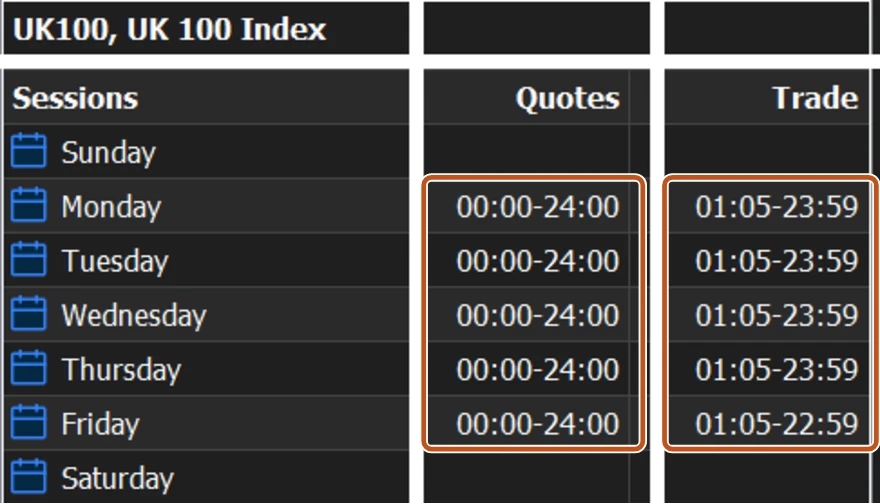
Your platform will happily quote an index symbol long after the exchange has closed. That price is not coming from share trades, because there are none. It is coming from the index future, which trades on a separate exchange for far more hours than the shares themselves.
- Outside cash hours there is genuinely less money in the market. The spread widens, and a large order moves the price further.
- The daily candle on your chart closes at your broker's server midnight, not at the exchange's closing auction. So the close you see on the chart is not the official index close reported in the news.
- Some brokers list two symbols for the same basket: a cash version quoted nearly around the clock and a dated futures contract with an expiry. They do not track each other perfectly, and only one of them expires.
The gap, and why a stop does not cover it
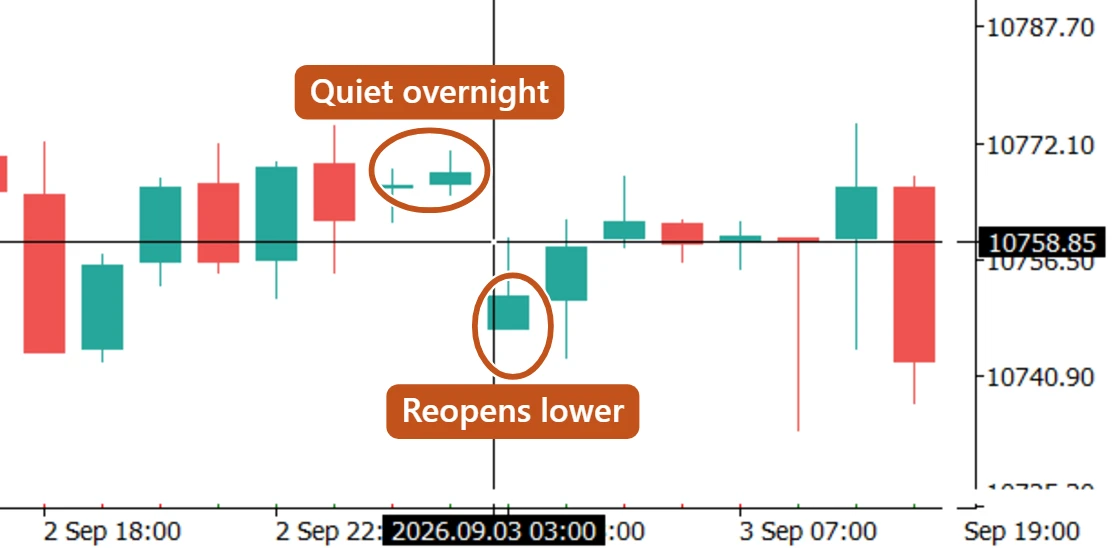
A gap is what you get when a market reopens at a level away from where it closed, with no trading in between. Forex gaps at the Sunday open. Indices gap far more often, because they close every single night and, more importantly, for the whole weekend, while the world keeps producing news.
This matters for one specific reason. A stop loss is not a promise about price. It is an instruction that becomes a market order when the level is touched, and it is filled at the next available price. If the market reopens beyond your stop, the next available price is the new open, and that is where you are filled. Part Two covered the mechanism in stop orders are hidden market orders, and the cost of simply holding through a closed period is time risk.

The market does not owe you the price you wrote on the ticket. It closes on Friday, the world carries on, and on Monday it opens where the news says. Anyone who tells you a stop protects you across a weekend is describing a market that does not exist.
- Exchanges also close on public holidays, and those holidays differ by country. Forex can be busy on a day when London or New York is shut, so an index symbol sits frozen while your other charts move.
- Around some holidays an exchange runs a half day and closes early. Its own calendar is the source of record for both the closures and the short days.
The picture to keep
The shop shuts on Friday evening and reopens Monday. Prices on the shelves are re-marked overnight, and no note you left on the counter changes what they are marked at when the doors open.