
Costs and mechanics

Somebody will tell you they caught fifty points on the Dow and you will have no idea whether that was a good afternoon or bus fare. Points are not pips, and until you read the contract you cannot turn a move into money.
A point is not a pip
A pip is a defined thing: on most currency pairs the fourth decimal place, on yen pairs the second, drilled in Part One's pips, lots and position size. Because the definition is fixed, traders can compare notes across platforms.
An index does not work that way. It moves in index points, and what a point is worth in money is whatever the contract specification says. That figure changes from symbol to symbol and from broker to broker, so fifty points on one platform's Dow symbol and fifty on another's can be two different amounts of money for the same market move.
Never carry a money-per-point figure across from one symbol to another, or from a friend's platform to yours. It is a property of the contract you were sold, not of the index.
Read the specification before you read the chart
In MT5 the answer lives in one window. Open Market Watch, right-click the index symbol, and choose Specification. Read these fields before anything else.
| Field | What it tells you |
|---|---|
| Contract size | How many index units one lot represents |
| Digits and Tick size | The smallest price step the symbol quotes |
| Tick value | The money that smallest step is worth on one lot |
| Minimal volume, Volume step, Maximal volume | The smallest position you may open and the increments allowed |
| Profit currency | The currency your result is calculated in before it reaches your balance |
| Swap long and Swap short | What holding overnight costs or pays on each side |
| Sessions | The hours this symbol quotes and trades, which is not the exchange's cash session |
Turning points into money
- The specification shows Tick size 0.10 and Tick value USD0.10 at a volume of 1.00 lot.
- One full index point is ten of those ticks, so one point on one lot is USD1.00.
- You are looking at a 45 point move on a 0.50 lot position.
- 45 points times USD1.00 per point times 0.50 lots.
USD22.50 on that move. Change the tick value, the contract size or the lot and the same 45 points produce a different number. The points belong to the market; the money belongs to the contract.
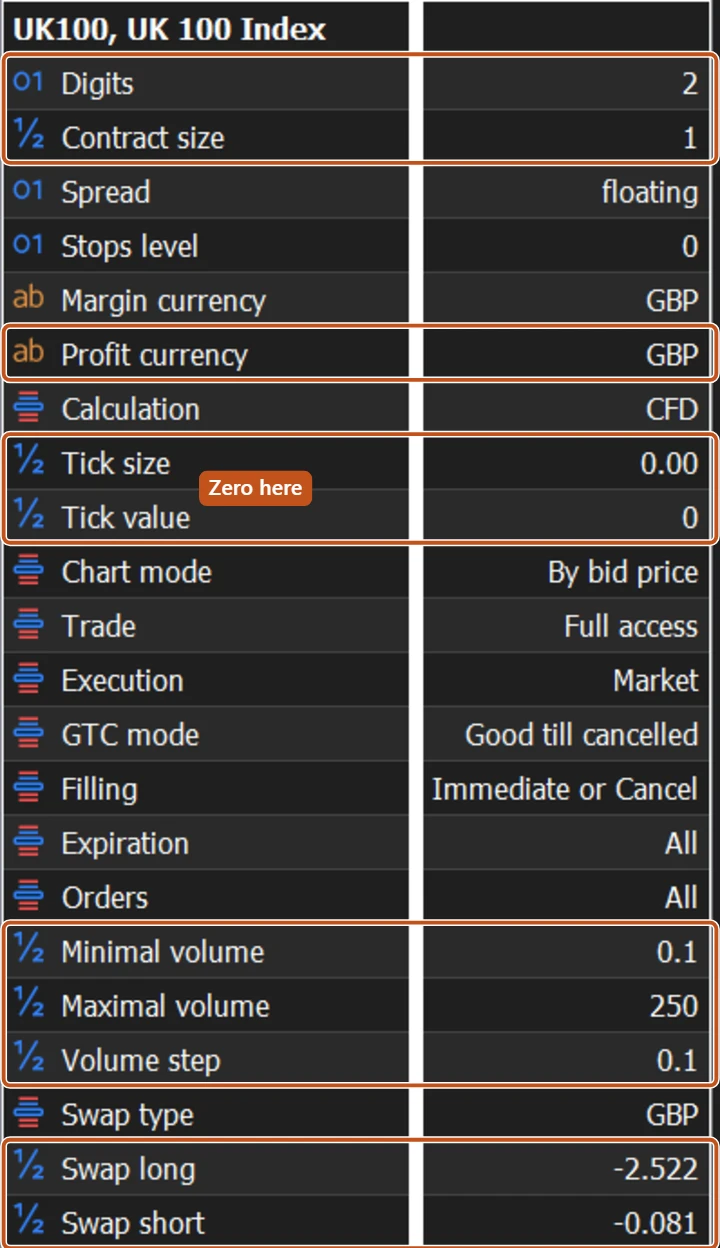
On the account pictured, Tick size and Tick value both read zero, which some brokers do. Then work from the Contract size instead: here it is 1, so one index point on one lot is worth 1 unit of the profit currency, one pound. The arithmetic in the example above still holds; only the starting number comes from a different line.
Trading carries risk and you can lose money.
Spread, financing and the entry nobody expects
The three costs from Part One all appear here, wearing index clothes. This is what changes.
- Spread is quoted in points, and on indices it is rarely fixed. It is at its tightest inside the cash session and widens outside it, at the open, and around scheduled releases.
- Overnight financing, shown as swap, is charged because an index position is leveraged. Holding for weeks makes this a running cost rather than a footnote, and Part One's leverage and margin explains why the charge exists at all.
- Dividend adjustments have no equivalent in forex at all, and they surprise people every quarter.
What a dividend adjustment actually is
Most headline indices are price indices: they track share prices and ignore dividends. When a company in the basket goes ex-dividend, its share price drops by roughly the dividend being paid, and the index level drops with it. Nothing has gone wrong. The value simply left the share price and went to shareholders as cash.
A trader holding an index position never receives that cash, so brokers correct for it. On the ex-dividend date an adjustment is applied to open positions: a credit on a long position, a debit on a short one. It appears on your account as its own entry, often labelled as a dividend in the account history or folded into the position's swap or commission field. It is not a price move and it will never show on your chart.

One quarter you will open your account and find a line you did not place, sitting against a short position you were holding. It is not an error and it is not the broker cheating you. It is the dividend adjustment, and it is a real cost on that side. Know it is coming before it arrives, not after.
The DAX is the exception people trip over. The headline German index is calculated as a performance index, so dividends are treated as reinvested and already sit inside the level. Positions on it usually carry no dividend adjustment at all, and one line on the provider's own factsheet settles which kind you are looking at.
The picture to keep
A point is a step on the wall chart. What that step is worth to you is written on the contract you signed, not on the wall.