
The market order

A market order is the simplest thing you can do on MT5, and the place where beginners give money away without noticing. The price you click is not always the price you get. Understand why before you press the button.
Buying at the tag
Walk into a shop, see the price on the tag, pay it, walk out. That is a market order. You are not negotiating and you are not waiting. You want the thing now, at whatever the shop is asking.
On MT5, a market buy fills at the current Ask and a market sell fills at the current Bid. The gap between those two is the spread, and you pay it the moment you are in. The lesson on bid, ask and spread covers why the trade starts slightly underwater.
Opening the ticket
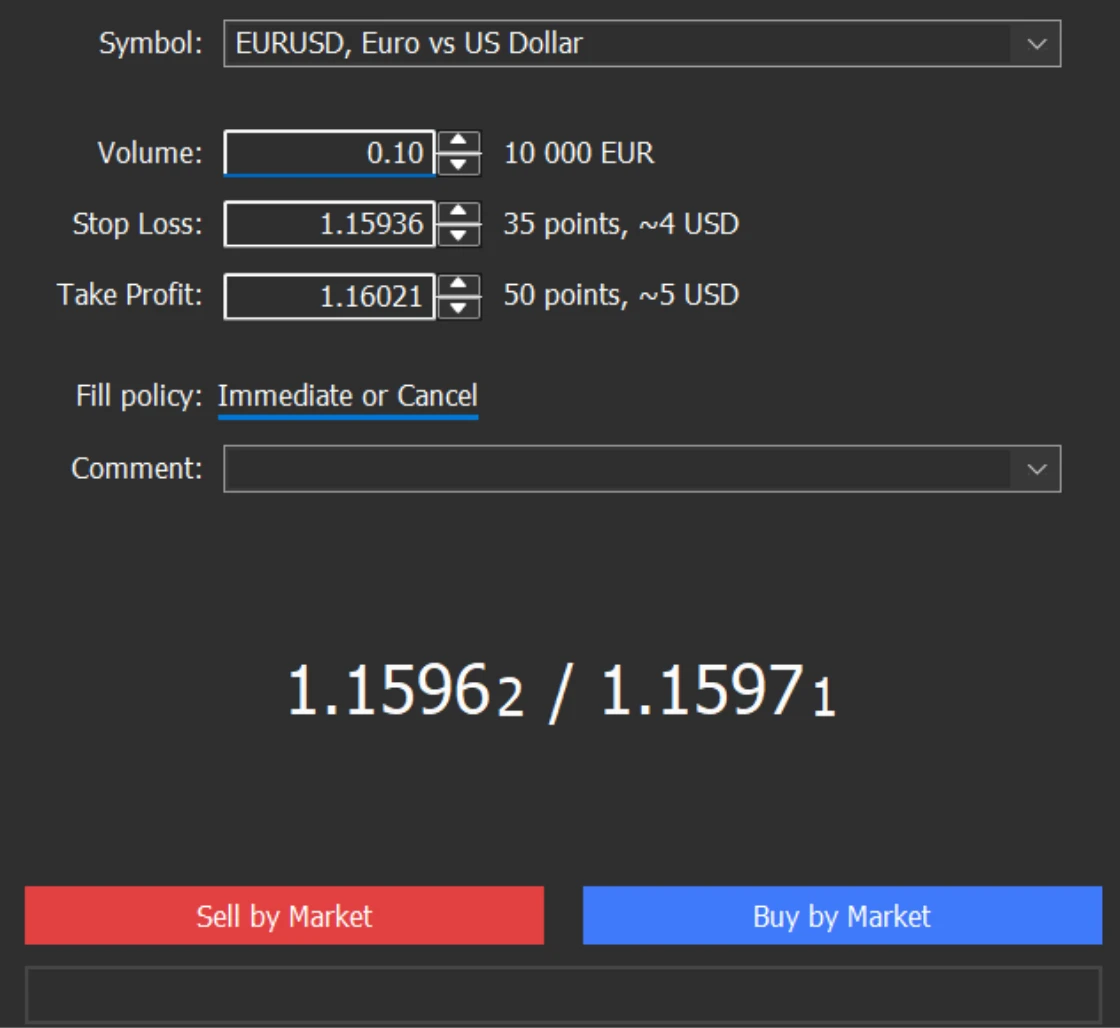
Press F9, or double-click a symbol in Market Watch, or right-click a chart and choose Trading > New Order. The New Order window opens with the order types listed down the left, the fields in the middle and a small tick chart on the right.
- Market Execution: the first entry in the list on the left. Click it if another entry is selected. Some brokers show Instant Execution there instead, explained below.
- Symbol: check it matches the chart you are looking at.
- Volume: the size in lots, worked out from your risk, never guessed. The position sizing lesson has the arithmetic.
- Stop Loss and Take Profit: typed as prices, not pips. Fill them in before you click, not after. Beside each box MT5 shows the distance in points and roughly what it is worth in money.
- Comment: optional text that follows the trade into the History tab.
- Fill policy: leave the default for now. Lesson 7 explains the choices.
- Click Sell by Market (red, showing the Bid) or Buy by Market (blue, showing the Ask).
Trading carries risk and you can lose money.
Instant execution versus market execution
Your broker sets one of two ways of filling a market order on each symbol, and the ticket changes shape to match. Open Specification from Market Watch and look at the Execution line to see which one you have.
| Instant Execution | Market Execution | |
|---|---|---|
| What you send | Buy or sell at the exact price shown on the button | Buy or sell at whatever the best price is when the order lands |
| If price moves first | The broker sends a Requote: a new price you can accept or refuse | The order fills anyway, at the new price. That difference is slippage |
| Extra field on the ticket | Deviation, the number of points you will accept away from the quote | None |
| The buttons read | Sell and Buy, with a price | Sell by Market and Buy by Market |
Neither is better. Instant execution gives you a say but can leave you unfilled in a fast market. Market execution always fills but the price is the market's choice, not yours. Two rarer modes, Request and Exchange, exist for some symbols; the same logic applies.

Market execution means you have agreed in advance to take whatever price is there when your order arrives. In a calm market that is the price on your screen. During a news release it can be a long way from it, and the fill is still yours.
When the market order is the right tool
- Price is already where your plan says to enter, and waiting would only mean missing it.
- The spread in Market Watch is at its normal size for that symbol and that hour.
- Your Stop Loss and Take Profit are typed in before the button is pressed.
It is the wrong tool when you are chasing a candle that has already moved, when a release is minutes away, or when the spread has widened. In those moments the shop's tag is not the price you will pay. The slippage lesson shows what that costs over a year.
A market buy on EUR/USD
- Market Watch shows EUR/USD Bid 1.08500 and Ask 1.08512, a spread of 1.2 pips.
- You press F9, set Volume to 0.10, type a Stop Loss of 1.08212 and a Take Profit of 1.09112, and click Buy by Market.
- The Trade tab shows the position opened at 1.08512, or a point or two either side if price moved while the order travelled.
- The position's profit column starts at roughly minus 1.2 pips, which on 0.10 lots is about 1.2 dollars, because you bought at the Ask and it is valued at the Bid.
The trade is in at the tag price. The spread is paid, the stop and target are already working, and nothing has been left to decide later.
Trading carries risk and you can lose money.
The habit that saves you
Glance at the tick chart on the right of the ticket before you click. Two lines, Bid and Ask, moving live. If they are jumping or the gap between them has opened up, close the ticket and wait. The shop will still be there in five minutes.
The picture to keep
A market order is walking into the shop and paying whatever is on the tag. If the tag changes while you are reaching for your wallet, you still pay the new tag.