
Partial closes and scaling out

A trade does not have to end all at once. You can take some of it off the table and let the rest run. That sounds like having it both ways, and I want you to see what it actually costs before you decide you like it.
What a partial close is
A partial close is closing part of the volume of an open position and leaving the rest open. You are long 0.30 lots, you close 0.10, and you are now long 0.20 with the same stop loss and take profit still attached to what remains. Scaling out is the plan behind it: a written rule for closing set fractions at set points along the way.
Think of a trader at a market stall who bought ten bags of rice at the morning price. By noon the price has moved up and she sells four bags, banking the gain on those. The other six stay on the stall in case the afternoon price is better. If it drops instead, she has already been paid on four.
Partial closes are neither better nor worse than closing all at once. They change the shape of your results: more trades that end as small wins, fewer trades that end as big wins. Whether that shape suits your plan is a journal question, not a matter of taste.
Doing it on MT5
- Open the Toolbox with Ctrl+T, Trade tab.
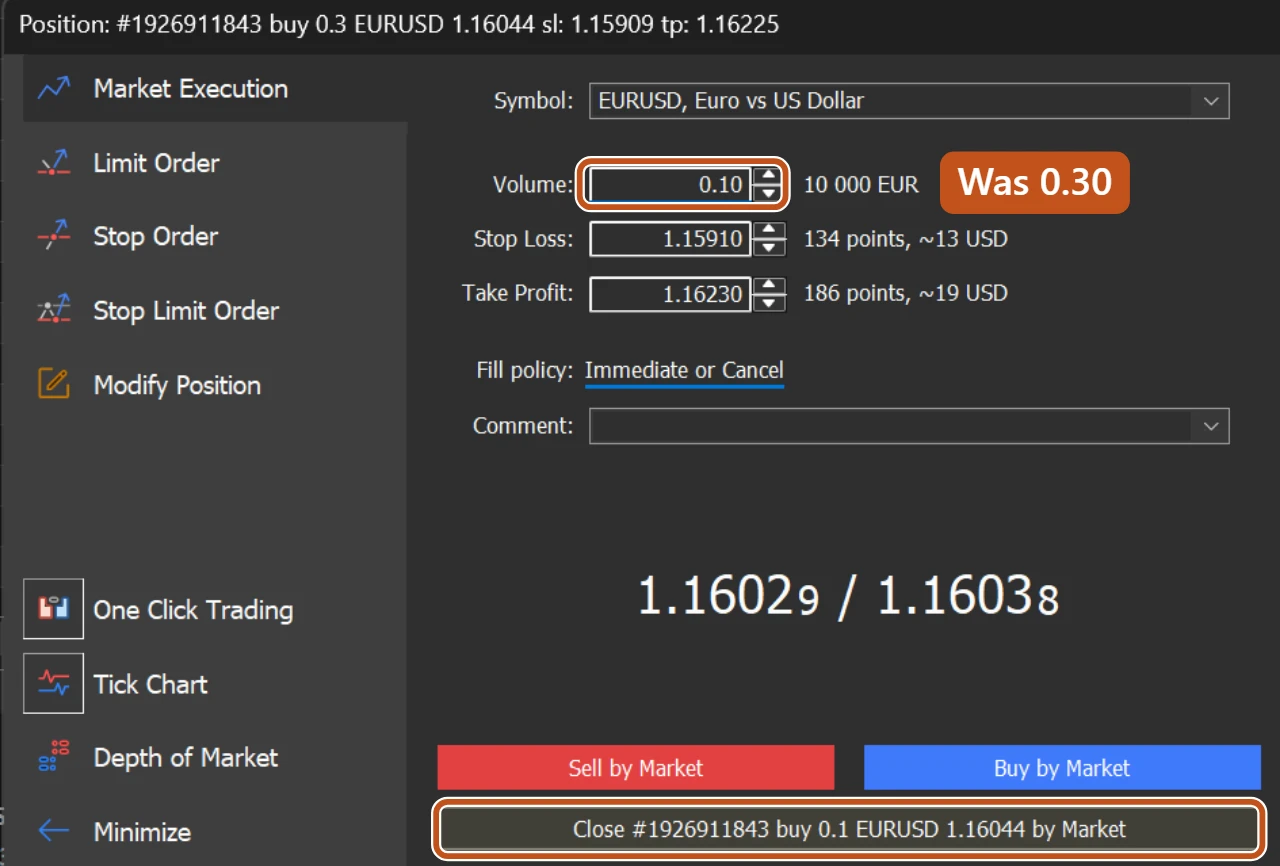
- Right-click the position and choose Close Position, or double-click the row. The order window opens with the Volume box already showing the full size of the position.
- Change the volume to the amount you want to close, for example 0.10 instead of 0.30. The long button along the bottom, under Sell by Market and Buy by Market, updates to read Close #1234567 buy 0.1 EURUSD 1.08500 by Market, or similar.
- Click it. The Trade tab now shows the same position with 0.20 lots, and the closed 0.10 appears in the History tab as its own deal.
The volume you type has to be a multiple of the symbol's Volume step, which you can read in the Specification window (lesson 10). On most forex symbols that step is 0.01, so closing 0.10 of 0.30 is fine and closing 0.005 is not. The Minimal volume applies to the part you leave open too: you cannot leave 0.005 lots running.
The X at the right of a row in the Trade tab closes the whole position. With One Click Trading switched on (next lesson) it does so without asking. The partial route is the window, never the X.
A scaling-out rule you can test
Thirds on a 0.30 lot position
- Position: buy 0.30 lots EURUSD at 1.08500, stop at 1.08200, which is 30 pips of risk.
- At one unit of risk in profit, 1.08800, close a third: 0.10 lots. Move the stop on the remaining 0.20 to true break-even.
- At two units, 1.09100, close another 0.10. The last 0.10 stays with the stop trailed behind the last swing low.
- If price reverses from 1.08800 straight to the entry, the trade banks the 30 pips on 0.10 lots and closes the rest at roughly zero.
Compared with holding 0.30 to the 60 pip target, the thirds plan banks less on the trades that run all the way and loses less on the ones that turn back at one unit of risk. Your journal decides which happens more often in your plan.
| Approach | On a trade that reaches the target | On a trade that reverses at one unit of risk |
|---|---|---|
| Close all at target | Full reward | Full loss |
| Close a third at each unit | Roughly two thirds of the full reward | A small win instead of a full loss |
| Close half at one unit, rest at target | Roughly three quarters of the full reward | A small win instead of a full loss |
Scaling in is a different animal
Adding to a position is scaling in. Adding to a winner because the plan says so at a defined level is a legitimate tactic with its own rules. Adding to a loser to lower your average price is called averaging down, and it is how a one percent risk becomes four percent while feeling like the same trade.

Adding to a losing trade is not a strategy. It is a bigger bet on the same wrong idea, placed by someone who does not want to be wrong. Take the small loss and keep the account.
The picture to keep
The rice seller who sells four bags at noon and keeps six for the afternoon has not outsmarted the market. She has chosen a smaller certain gain over a larger uncertain one, and that trade-off is the whole of scaling out.